

China Train Travel
- Updated:
- Sep 24, 2009;
- by:
- China Highlights;
- Clicks:
- 1249;
Traveling by train in China is one of the cheapest ways to travel some of the long distances in China and is used widely by the local population. It is important to know what to expect if you decide to travel by train in China.
If you choose to travel by train, China Highlights recommends booking a soft sleeper.
The restaurant carriage will be the 10th car. The choice of food will be limited and only Chinese food will be available. Most local people buy food in advance or buy food from the vendors on board the trains.
English is generally not spoken by any of the staff on the trains or in the railway stations. Limited English sign is available in the railway stations. A separate waiting lounge is available in the railway stations for passengers traveling in the soft sleeper section. Preferential boarding is available for those passengers.
Baggage space is limited and must be stored in your compartment so it is wise to travel with small baggage rather than large suitcases. Most train stations have a considerable number of stairs to climb to reach the platforms. Bags have to be carried up and down these stairs. Most stairs have a steep ramp so that wheeled bags can be dragged up as you walk up the stairs.
Train travel in China has to be undertaken with the full knowledge that the system is designed for the local population who are familiar with the standard conditions. Trains between larger cities are always superior to those on lesser routes and will probably run close to schedule.
The system for rail reservations in China will only allow Travel Agencies including China Highlights to confirm bookings 2 days prior to departure of the train.
We provides a 98% success rate for obtaining tickets for reservations. We do however reserve the right to change your scheduled itinerary and mode of transport if required.
If you would like more information about train travel in China or want to ask a question to help you decide if train travel in China is for you please feel free to contact us. We will reply you within one working day.
Four Classes of Chinese Trains
The accommodation on trains is divided into seven categories, and they are introduced as follows.
- Hard Seat (Yingzuo)
It is the cheapest option, and the coaches are usually overcrowded. Though the seats are actually thinly padded, you could hardly sleep on the upright seats. Smoking is permitted here so there is no air-conditioning. The coaches are not clean, and you would never want to visit the toilet. It is usually not advised to buy hard-seat tickets when there are other options available. - Soft Seat (Ruanzuo)
It is one level above the hard seat, and the fare is slightly higher. The seats are relatively cleaner and more comfortable. There will be no over-crowding in soft-seat coaches. In some trains air-conditioning is available. Smoking is not allowed in the coach, but you can smoke at the corridor between cars. Soft seats are ok for several hours’ ride. - Hard sleeper (Yingwo)
It is the basic accommodation for overnight or long-distance train travel. The coach has doorless compartments, in which six bunks are arranged, with three tiers of bunks (upper/middle/lower) on both sides. There is a small difference of price between the bunks, with the upper bunk being the cheapest and the lower bunk the most expensive. A pillow and a sheet are provided for each bunk. There is a small TV hanging in each compartment. Air conditioning is available, and the washroom is tolerably clean. Smoking is not permitted in the coach, but you can smoke at the corridor between cars. - Soft Sleeper (Ruanwo)
It is sort of a luxurious train travel, with the fare almost twice as much as that of the hard sleeper, and sometimes even as much as that of discounted flights. Each compartment is enclosed by a door, and contains four bunks, with two to a side. The bunks are wider and more comfortable, and there is an LCD TV for each bunk. Air-conditioning is available, and the washroom is clean. Smoking is not permitted in the coach, but you can smoke at the corridor between cars. It is advisable to buy soft-sleeper tickets for overnight and long-distance travel. - First Class Seat (Yidengzuo)
They are available in D trains (Dongche). Four seats are arranged for a row. The seats are similar to soft seats, but are wider, more modern and comfortable. Smoking is not allowed. - Second Class Seat (Erdengzuo)
They are available in D trains. Five seats are arranged for a row. It is a level below the first class seats with relatively smaller sitting area, but is still comfortable. Smoking is not allowed. - Luxury Soft Sleeper (Gaobao)
It is the top level sleeper, and the fare is much more expensive than that of soft sleepers. It is only available in a few trains. Each enclosed compartment contains only two clean and comfortable bunks (upper/lower), a western washroom, and sometimes even has a shower cubicle. The ground is carpeted, and other facilities include sofa, LCD TV, table and wardrobe.
Note
- English is not spoken by railway staff. Limited English signs are available at railway stations. A separate waiting lounge is available in the railway stations for passengers traveling in the soft sleeper section. Preferential boarding is available for those passengers.
- Baggage space is limited and must be stored in your compartment so it is wise to travel with small baggage rather than large ones. In most stations you will need to climb up or down a considerable number of stairs, with a steep ramp, before you reach the platform. It is advisable to bring baggage with wheels.
- At the end of each car, there will be hot water provided for free.
- Please don’t forget to bring toilet paper since it is not available in the washrooms.
- Pickpockets are ubiquitous at train stations or on the train, please keep your baggage and valuables safe, and never leave them unattended.
Train Travel Tips
- Make sure you get to the correct station
In some cities, there are 2 or several train stations, which are distant from each other. Before you start, please make sure from which station you are going to board the train. If you get to the wrong station, you probably won’t have enough time to catch the train.
It is suggested that you get to the train station at least 30 minutes before the train departs, if during peak seasons, 1 hour ahead of time is better. - Pass security control
When you arrive at the station, you first need to go through the security control at the entrance. Please put your luggage through the X-ray machine and fetch them on the other side. Animals, knives, flammable, toxic and explosive goods are forbidden on the train. - Find the correct waiting lounge
The electronic message board will show the correct waiting lounge for each train. You will easily find which one is your waiting lounge as long as you know your train number and departure time. Or you can ask the staff for help. Tickets will be checked when you enter the lounge, so you can be sure you are in the correct lounge.
A separate waiting lounge is available in the railway stations for passengers traveling in the soft sleeper section. Preferential boarding is available for those passengers. - Go to the platform
About 10 minutes before the train departs (30 minutes if you are departing from the train’s starting station), the announcements of check-in will be broadcast, and the conductor will direct passengers to the appropriate track to check in and go to the platform. - Board the train
You can easily find your carriage because the numbers are marked clearly on the carriage. A train attendant waits at the door of each carriage and checks the tickets. After you board the train, find your seat or bunk, and put your luggage in place. Please keep an eye to your belongings, and always keep your valuables securely close to you.
Note
- Please make sure beforehand from which station you are going to board the train, and arrive at the correct station at least 1/2 – 1 hour ahead of the departure time.
- Baggage Allowance: Each child will be allowed to take 10 kg (22 pounds) of baggage for free, and 20 kg (44 pounds) is allowed for an adult passenger.
- At hard or soft sleeper class carriages, shortly after the train departs, a train attendant will walk through the carriages to collect tickets. He/she will give you a plastic card. Please keep the card because you are required to present the card about half an hour before reaching your destination, when you will get your ticket back. The ticket will also be checked when you go through the exit of train stations.
- During stopovers along the journey, if you decide to get out and breathe some fresh air, it is advised that you do not wonder far way from the train, in case it might leave before you get back.
- English is not spoken by railway staff. Limited English signs are available at railway stations. If possible, please get a phrase book in case of emergency. In fact, In China, more and more people, especially the younger generations can speak some English; you can ask them for help.
- Most trains have dining cars serving passable Chinese-style food, usually located at Car 7, 8 or 9 at the middle of the train. The railway staff also walk by regularly with pushcarts selling boxed lunches, instant noodles, soft drinks, snacks and so on.
- The washroom is usually located at the end of each car. The washroom is locked when the train is approaching one stop, and it opens when the train runs again. .Please bring your own toilet paper since it’s not available inside.
- Baggage space is limited and must be stored in your compartment so it is wise to travel with small baggage rather than large ones. In most stations you will need to climb up or down a considerable number of stairs, with a steep ramp, before you reach the platform. It is advisable to bring baggage with wheels.
- Pickpockets are ubiquitous at train stations or on the train, please keep your baggage and valuables safe, and never leave them unattended.
- Please check and take all your belongings with you when you get off the train. If you leave anything behind, it is probably impossible to trace back.
Classification of China Trains
In China, train numbers are usually indicated with a capital letter followed by several numerals. The letter indentifies the category of the train, which is often determined by speed and the number of stops the train will make during the journey. The better categories accordingly represent the higher level of price, speed, service, facilities and cleanness, and fewer number of stops along the way. The common used letters (categories) are as follows:
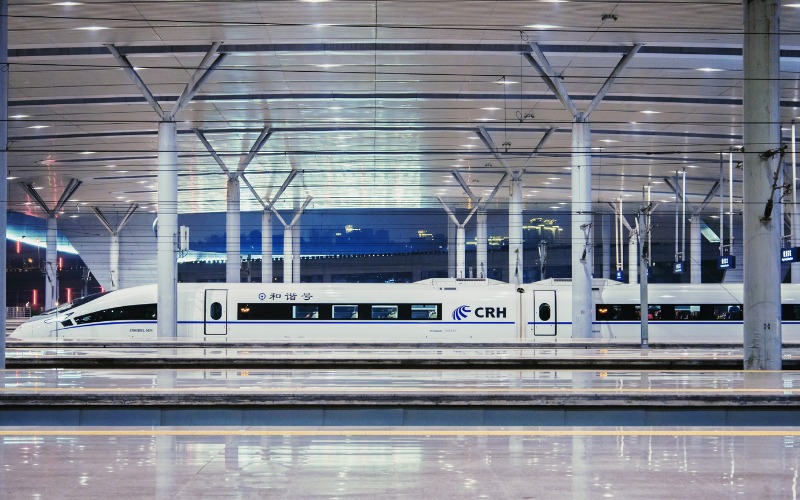
- D trains – Multiple Unit Train or Bullet Trains (Dongche)
They are the fastest (over 200 km/hr or 124 miles/hr) in China, and provide frequent service between the main cities centered around Beijing and Shanghai, such as trains Beijing/Shanghai, Beijing/Zhengzhou, Guangzhou/Shenzhen, Shanghai/Hangzhou, Shanghai/Nanjing, and so on. Trains only stop at a few major stops along the way.
The coaches are modern and air-conditioned. First-class seats (soft seats) and second-class seats (hard seats) are available, while for some long-distance overnight trains, such as Beijing/Shanghai, there are soft-sleepers available. The washrooms are relatively clean, with closestools.
- Z trains – Direct Express (Zhida)
The second fastest (160 km/hr or 99.4 miles/hr) in China, though its name implies “non-stop”, some do have several stops along the way, but only at major stations. The coaches are modern and air-conditioned. They are usually overnight trains, so there are usually only sleepers (hard/soft) available, while some only have soft-sleepers available. The trains serve main cities, such as Beijing, Shanghai, Xi’an, Wuhan, Shenzhen, as well as Hangzhou and Ningbo.
- T trains – Express Trains (Tekuai)
T trains run at 140 km/hr or 87 miles/hr, and have limited number of stops along the way, at major cities or some junctions. All the major cities with railways can be reached by taking T trains. The coaches are modern and air-conditioned. Both seats (hard/soft) and sleepers (hard/soft) are available.
- K trains – Fast Trains (Kuaisu)
K trains run at 120 km/hr or 74.6 miles/hr, and stop at more stations than the T trains. Besides stopping at cities, they will also stop at main counties along the way. Both seats (hard/soft) and sleepers (hard/soft) are available. The coaches are not so modern and clean as those mentioned above, and air-conditioning is not always on, but they are still tolerable.
Useful Tools for Planning a Pleasant China Trip: China Travel Guide Book, Chinese Phrase Book, Travel Checklist, Travel Insurance, Currency Converter, Time Difference, Visa Application, Phone Rentals, Chinese Embassy, China Zip Codes, China Train Search, China Maps, China Weather Forecast, China Time Difference... more China Travel Tools »
US Dollar
Euro
GB Pound
CA Dollar
AU Dollar
Swtz Francs
HK Dollars


