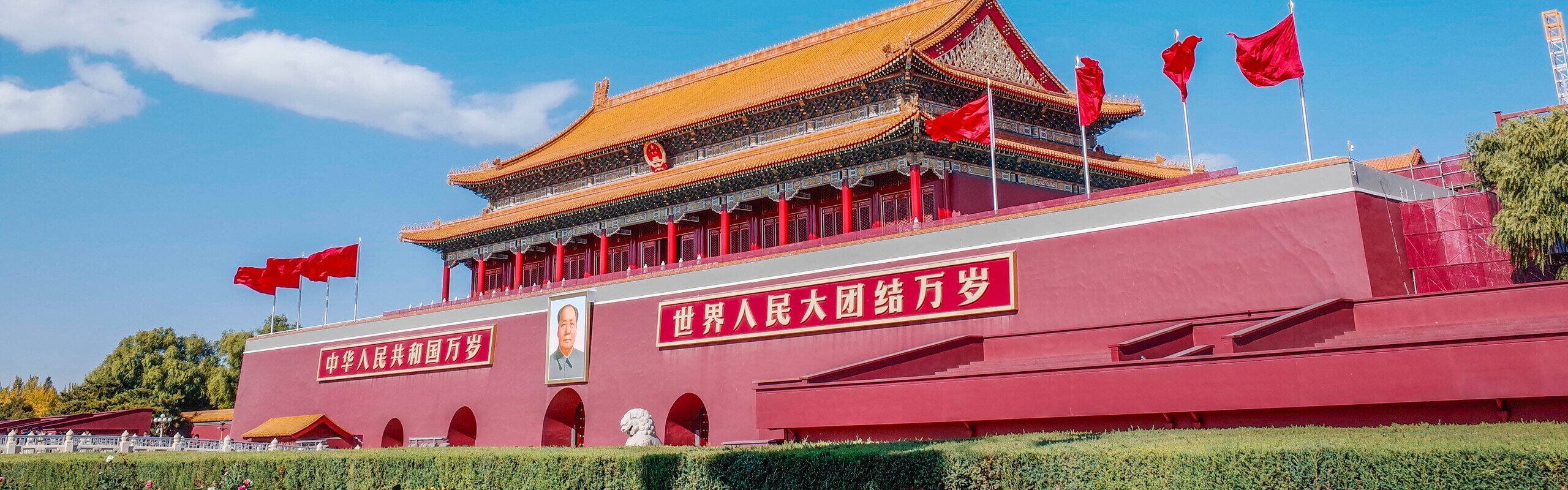

The impressive expanse of Tian'anmen Square has hosted momentous events like the declaration of the People's Republic of China by Chairman Mao in 1949, and is surrounded by a host of world class sights, from the Forbidden City to China's National Museum.
Tian'anmen Square: Meaning in Chinese and Pronunciation
Tian'anmen Square, or less correctly Tiananmen Square, is named after the Tian'anmen gate to its north, separating it from the Forbidden City. The gate's literal name 'Heaven Peace Gate' (天安门 Tiān'ānmén /tyen-an-mnn/) is usually translated "Gate of Heavenly Peace".
The Size of Tian'anmen Square
Tian'anmen Square is the largest famous world square, eclipsing Delhi's India Gate Complex and Warsaw's Parade Square, on its expansion in 1959. It fulfilled Chairman Mao's vision of being the largest square in the world for 17 years, until 1976, the year Mao died.
It's now the seventh largest city square in the world (and the fourth largest in China [2019]), at 440,000 square meters (109 acres) in size. It can hold about 1 million people for public celebrations or gatherings.
- 4-Day Beijing Private Tour to Visit the Great Wall at Night
- Half-Day Beijing Walking Tour in a Neighborhood
What Tian'anmen Square Is Famous For
Tian'anmen Square has great cultural significance as it has been the site of several important events in Chinese history.
- The May Fourth Movement was an anti-imperialist and political movement mainly involving students. On May 4, 1919, they protested against the Chinese government's weak response to the unfair Treaty of Versailles, marking the upsurge of Chinese nationalism.
- Chairman Mao officially proclaimed the founding of the People's Republic of China from Tian'anmen Rostrum overlooking the square on October 1, 1949.
- Today, Tian'anmen Square still hosts ceremonies and National Day anniversaries as well as many significant foreign and domestic affairs and events.
What's Special about the 2019 Tian'anmen Military Parade?
It will be the biggest military parade in China in many years. All weapons on display are made in China. The parade will last around 80 minutes and 15000 people are involved in this huge event. In addition to this, there will be 160 aircraft, 580 sets of equipment and 59 squads (15 marching squads, 32 equipment squads, 12 air force squads) in the military parade.

4 Interesting Facts about Tian'anmen Square's Military Parades from 1949 to 2015
- Air force troops were actually armed with live weapons in the military parade that took place on October 1, 1949, because they were also on a security mission for the proclamation of the founding of the People's Republic of China.
- Some 24,209 troops were inspected during the military parade on National Day in 1950, which was the first anniversary parade after the declaration of the People's Republic of China. By far, that parade contained more troops than any other.
- Troops with female soldiers were first inspected during the parade held there on National Day in 1984.
- Veterans from World War II joined the parade for the first time on September 3, 2015 - the 70th anniversary of World War II.
- 6-Day Beijing Winter Tour with Skiing in a 2022 Olympic Winter Games Venue
- 1-Day In-Depth Beijing Culture Tour
Top Things to Do in Tiananmen Square
- Climb Tian'anmen Rostrum for a panoramic view of the world's largest public square.
- Attend the national flag-raising ceremony every morning at sunrise.
- Visit the National Museum of China.
- Go to the Mausoleum of Mao Zedong, where you will see the body of the great Chinese leader.
- Visit the magnificent Forbidden City.
Tian'anmen Square's Layout and Attractions
Tian'anmen Square is a huge space in front of the former imperial palace called the Forbidden City.
Tian'anmen, the Gate of Heavenly Peace, at the north of the square, is the main gate to the Forbidden City.
Zhengyangmen (meaning 'Gate of the Zenith Sun' and now commonly known as Qianmen), to the south of the square, marks the southern entrance into the heart of old Beijing.
Standing at Tian'anmen and facing south, you can see the Great Hall of the People on the right, the National Museum of China on the left, and to the far south the national flag stage, the Monument to the People's Heroes, the Mausoleum of Mao Zedong, and Zhengyangmen in that sequence.
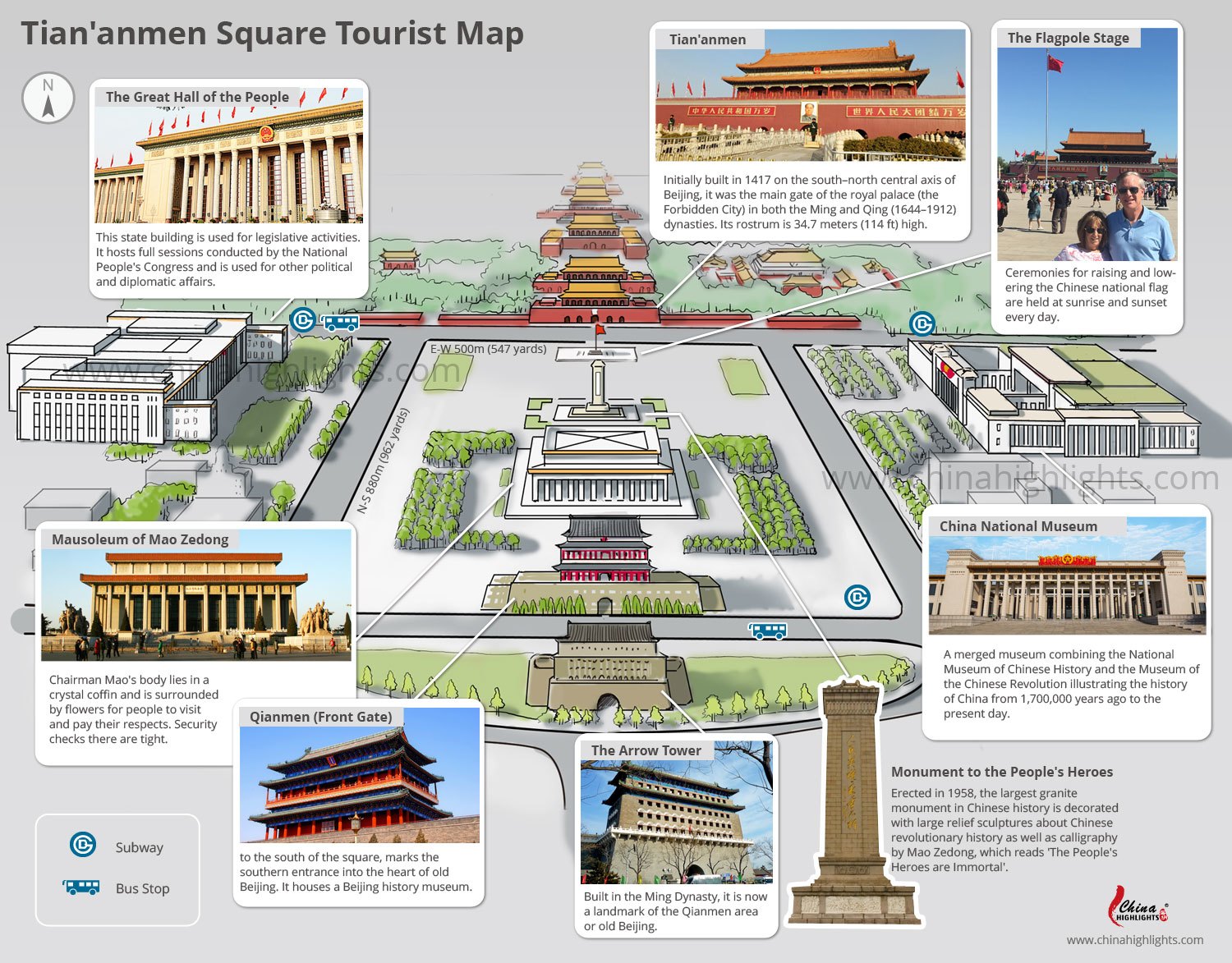 The latest Tian'anmen Square tourist information and layout infographic: click to enlage. Please contact us to use this copyrighted image.
1.Tian'anmen Rostrum
Tian'anmen RostrumTian'anmen, initially built in 1417 during the Ming Dynasty (1368–1644) and located on the south–north central axis of Beijing, was the main gate of the royal palace in both the Ming and Qing dynasties. Ordinary people were not allowed to pass through this gate and enter the Forbidden City until 1911 when the last feudal kingdom collapsed.
Tian'anmen was initially called Chengtianmen (Chinese: 承天门, meaning 'Gate of Heavenly Succession'), which means to bear the edict and divine power of heaven itself, just as the emperor, who used this gate, was believed to.
In the eighth year of emperor Shunzhi's administration (1652), the gate was refurbished and called Tian'anmen ('the Gate of Heavenly Peace'). From then on nearly all important imperial celebrations and events involved passing through this gate, such as the enthronement of an emperor, imperial weddings, the rite of the emperor going to battle, and the worship of Heaven and Earth.
The magnificent main gate to the imperial palace has five openings. During the Ming and Qing dynasties (1368–1912):
- The middle entrance leading to the Forbidden City was reserved for the emperor himself. He went through the central passage on the way to the altars for rituals and other religious activities.
- The side entrances were used by high-ranking government officials as well as the empresses, concubines, princes, and princesses.
- Ordinary subjects were absolutely forbidden to go inside the Forbidden City, hence its name.
Golden Water Bridge in front of the RostrumThe 34.7-meter-high Tian'anmen Rostrum seems even more magnificent in the sunshine, with glittering yellow glazed tiles on the roof and deep red walls and pillars.
Before Tian'anmen are the Golden Water Bridge and the white Huabiao, a pair of ornamental columns made of white marble sculptured with dragon designs. They are also called "slander pillars", as in ancient times they carried the ordinary people's slander and suggestions for the emperor. There is also a pair of big stone lions on Tian'anmen Square.
2.The Great Hall of the People
This state building is used for legislative activities. It hosts full sessions conducted by the National People's Congress and is used for other political and diplomatic affairs.
3.The National Museum of China
This is now a merged museum, combining the National Museum of Chinese History and the Museum of the Chinese Revolution. Cultural relics, martials, and photographs illustrate the history and charming culture of China from 1,700,000 years ago to the present day.
4.The Monument to the People's Heroes
The Monument of People's HeroesErected in 1958, the largest granite monument in Chinese history is decorated with large relief sculptures about Chinese revolutionary history as well as calligraphy by Mao Zedong, which reads 'The People's Heroes are Immortal'.
5.The Mausoleum of Mao Zedong
Chairman Mao's body lies in a crystal coffin and is surrounded by flowers for people to visit and pay their respects. Security checks there are tight.
- 4-Day Beijing Private Tour to Visit the Great Wall at Night
- 6-Day Beijing Chinese New Year Tour
- 1-Day Beijing Hutong Tour
Flag Ceremonies at Tian'anmen Square
Tiananmen SquareCeremonies for raising and lowering the Chinese national flag are held at sunrise and sunset every day.
Every morning at sunrise, a flag-raising ceremony is conducted by uniformed troops. The entire ceremony lasts for less than 3 minutes. The flag is raised very slowly and is timed precisely at 2 minutes and 7 seconds to coincide with the sun, which takes the same time to rise above the horizon.
The squad of troops emerge from Tian'anmen Tower a few minutes before sunrise, and they march to the flagpole in formation across a bridge in front of Tian'anmen Tower.
Tips for Watching the Flag Ceremonies
- On important national holidays, crowds of thousands usually wait to see the ceremonies. During bad weather conditions, only a small crowd gathers there.
- If you want to get close to see the troops or to stand near the flagpole for a better view, you need to get there early enough.
- There is a national anthem played so, if you know the words, you can sing along with the rest of the crowd.
- To get into the square, you have to go through a security check. It is best not to try to take in a lot of baggage with you but, if you have small handbag, that will be checked before you are allowed to enter.
- After the flag-lowering ceremony, the police will politely ask members of the crowd to stop lingering.
Tian'anmen Square Travel Tips
Getting There
By Subway (Recommended) :Take Beijing subway Line 1 to Tian'anmen East Station or Tian'anmen West Station, or Line 2 to Qianmen Station.
By Taxi: Show the following phrase to the driver: 请带我去天安门广场. It means 'Please take me to Tian'anmen Square'. Taking a taxi is not recommended as it is hard to locate places to flag one down because parking is restricted at this national site.
By Sightseeing Bus Line 1 and 2
At present,there are 3 sightseeing buses introduced to tourist in Beijing, both sightseeing bus Line 1 and Line 2 go to Tian'anmen Square. Learn more about Beijing Sightseeing Buses.
Things to Be Aware Of
- Although Tian'anmen Square has tight security checks, visiting the square is free.
- The queue to get into the square will start across the road if it's a busy day.
- Visitors to the mausoleum cannot take anything with them except for their wallet and phone. There is a little cabin to utilize for bag storage.
- Don't be surprised if Chinese tourists try to talk to you. In most cases, they probably just want to take a photo with a Westerner as it is a lovely memory of their trip.
- Don't take prohibited items into the square, such as a knife or other items that are regarded as being dangerous to the public.
- Don't talk about sensitive political issues.
Top Tours Including Tian'anmen Square
Tiananmen squareTian'anmen Square is a landmark of Beijing and full of history and culture. To travel with a professional guide is necessary and helpful if you want to learn about the history behind Tian'anmen Square. Please feel free to contact us for a tailor-made tour or if you need any assistance with your tour arrangements.